Open letter
Your public language is drenched in empathy. Your administrative design is not.
You praise the courage it takes for survivors to come forward. You speak of safety, voice and belief. Then the system meets a disclosure that did not arrive on schedule and responds with a closed file.
That is not trauma-informed justice. It is administrative tidiness wearing a compassion lanyard.
The National Redress Scheme’s single-application principle assumes that a survivor can compress a childhood, its abuse, the institutions involved and the long afterlife of trauma into one complete and final submission. It mistakes the form for the truth and the deadline for the end of memory.
A government cannot nod solemnly at trauma science, then write the law as if survivors disclose like accountants closing a file.
The question is not whether administrators followed the rule. The question is why governments continue to defend a rule that can punish the very patterns of delayed and partial disclosure their own evidence recognises.
Trauma does not keep office hours
The Royal Commission found that disclosure is rarely a single event. It can be partial or complete and may unfold over time. Across 4,817 private sessions, survivors took an average of 23.9 years to tell someone about the abuse. The average was 20.6 years for females and 25.6 years for males. [3]
This matters because “repressed trauma” is often turned into a rhetorical fight about labels. The administration does not need to endorse one contested phrase to recognise the established reality: traumatic memory can be fragmented, disclosure can be delayed, and survivors may not identify every act, person or institution in one telling.
That reality is not obscure. It sits in the public record the Scheme was created to answer.
What section 71B actually does
Section 71B is not a general second chance. It creates a narrow reassessment pathway tied to participating institutions and prescribed circumstances. Current Scheme guidance says reassessment is available to some people whose applications were finalised before an institution named or identified in their original application later joined the Scheme. [1] [2]
That does not solve the central problem. If additional abuse or another responsible institution is disclosed after finalisation, but was not named or identified in the original application, the single-application rule may leave the survivor outside the pathway.
Knowmore has warned that this design can exclude survivors who were not ready or able to identify all abuse when they first applied. The Australian Government’s response to the Scheme’s second-year review nevertheless said the single-application principle remained important. [4] [5]
Important to whom?
Administrative finality is convenient. It is not sacred. If a legal design repeatedly collides with a known feature of trauma, the law is not being neutral. It is choosing the convenience of the file over the reality of the survivor.
The numbers you publish, and the numbers you don’t
The Scheme’s June 2026 update reported 80,483 applications received by 31 May 2026, 28,858 outcomes advised, 22,775 payments totalling about $2.02 billion, and 5,275 applications withdrawn or closed. It also reported 46,350 applications awaiting an outcome. [6]
It reported ordinary review activity too: 329 reviews requested in the preceding six months, 117 completed, with 34.2 per cent of completed reviews producing a higher payment. [6]
What the public update did not report was a Section 71B breakdown. No count of requests. No count accepted. No count refused. No reasons. No jurisdictional pattern. No processing times.
That silence is not a footnote. It is an accountability gap. A government cannot insist that a narrow pathway is adequate while withholding the basic data needed to test whether it works.
Victoria is not an innocent spectator
Victoria joined the National Redress Scheme. The Commonwealth runs it, but Victoria participates in it, and Victorian agencies coordinate that participation and deliver parts of the response. [7] [8]
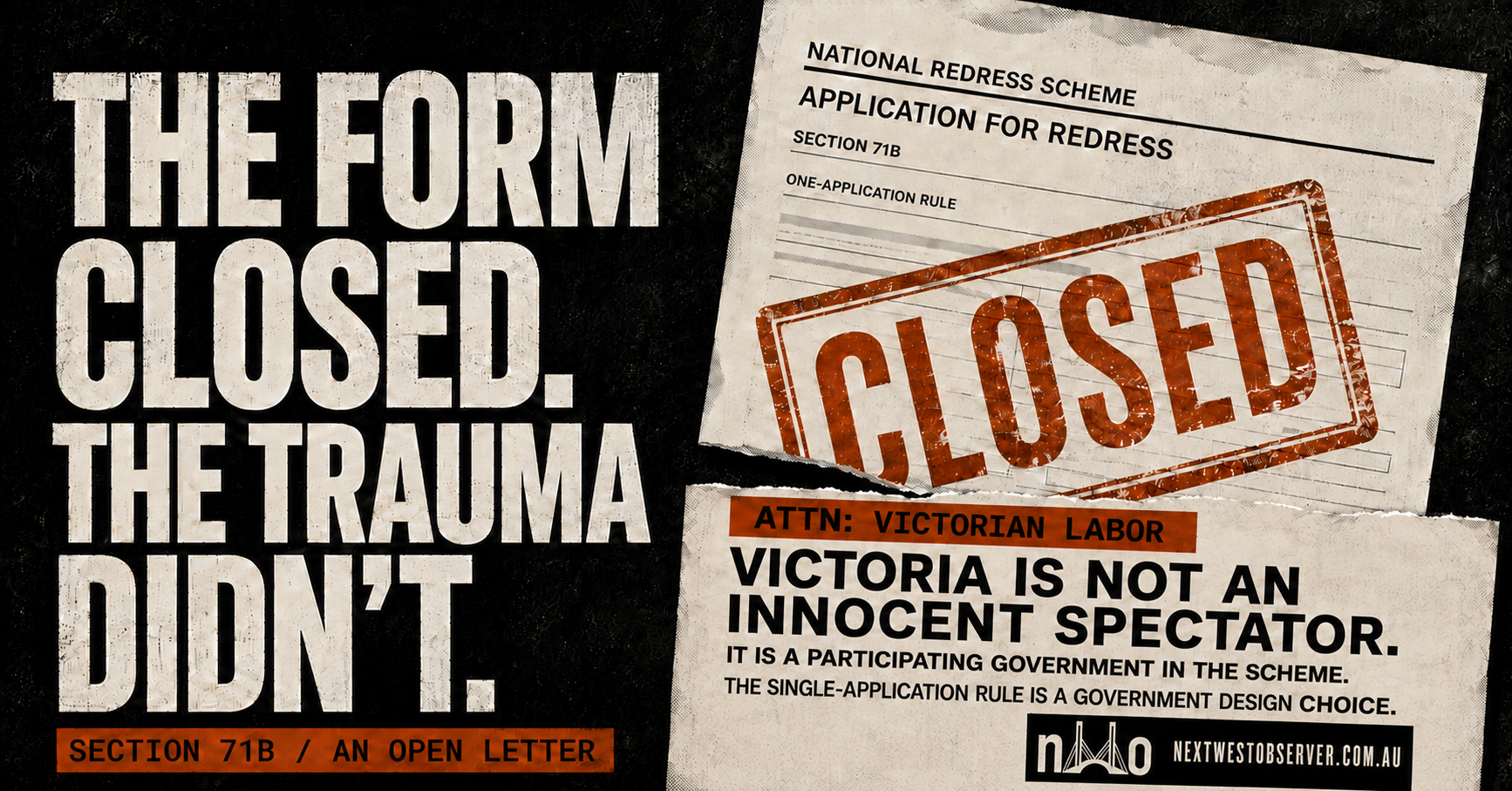
So, attention Victorian Labor: Victoria is not an innocent spectator. It is a participating government in the Scheme. The single-application rule is a government design choice.
Shared governance does not mean shared invisibility. It means shared responsibility.
If Victorian Labor believes victim-survivors deserve a justice system that believes them, protects them and holds perpetrators to account, that belief must survive contact with an inconvenient file. It must include a survivor whose disclosure did not arrive in one administratively perfect package.
Two matters, no disclosures
Material supplied to NWO concerning two separate matters points to the same administrative wall: information disclosed after an original application was finalised was treated as outside the available pathway.
NWO is not publishing the survivors’ accounts, identities, institutions or correspondence. We make no finding here about the underlying abuse or any responsible institution. The policy issue can, and must, be examined without turning private trauma into public spectacle.
The two matters are not offered as a statistical sample. They are a warning flare. The missing Section 71B data means the public cannot know how many other people have reached the same wall.
That is precisely why ministers should not answer with anecdotes, sympathy or another referral to civil litigation. The point of redress was to provide an alternative to combative court processes. Sending survivors back toward litigation because the Scheme cannot accommodate later disclosure is not a remedy. It is policy abandonment with a brochure attached.
What must change
- Publish annual Section 71B data: requests, eligibility decisions, approvals, refusals, reasons, processing times and jurisdictional breakdowns.
- Amend the Act and Scheme rules to permit a supplementary application where materially later disclosure identifies additional abuse or another responsible institution.
- Create an independent, trauma-informed review pathway, with reasons that can be understood and challenged.
- Guarantee no detriment to an existing payment or offer merely because a survivor seeks to add a later disclosure.
- Stop treating civil litigation as the default escape hatch for failures in a scheme designed to avoid retraumatising court battles.
- Publish the positions governments take through the Scheme’s intergovernmental governance, including Victoria’s position on reform of the single-application rule.
The questions
Tanya Plibersek. Mark Butler. Victorian Labor. Answer plainly:
- Do you accept the Royal Commission’s finding that disclosure is a process, not a single event?
- How many Section 71B requests have been made, accepted and refused?
- What position has Victoria taken on expanding reassessment beyond the narrow current pathway?
- Will you support a supplementary application mechanism before the Scheme closes?
You cannot keep borrowing the language of courage while outsourcing the consequences of cowardice to a form.
The form may be closed. The moral file is not.
Sources
- National Redress Scheme for Institutional Child Sexual Abuse Act 2018, including section 71B.
- National Redress Scheme, What happens after applying, current reassessment guidance.
- Royal Commission, Identifying and disclosing child sexual abuse.
- Knowmore, submission to the Joint Standing Committee on implementation of the Scheme, discussion of section 71B and later disclosure.
- Australian Government response to the second-year review of the National Redress Scheme.
- National Redress Scheme update, June 2026, data at 31 May 2026.
- Victorian Government, National Redress Scheme.
- Victorian Department of Families, Fairness and Housing, Scheme participation and implementation.
SupportThis article discusses institutional child sexual abuse and redress. Information about free, confidential Redress Support Services is available through the National Redress Scheme support directory.